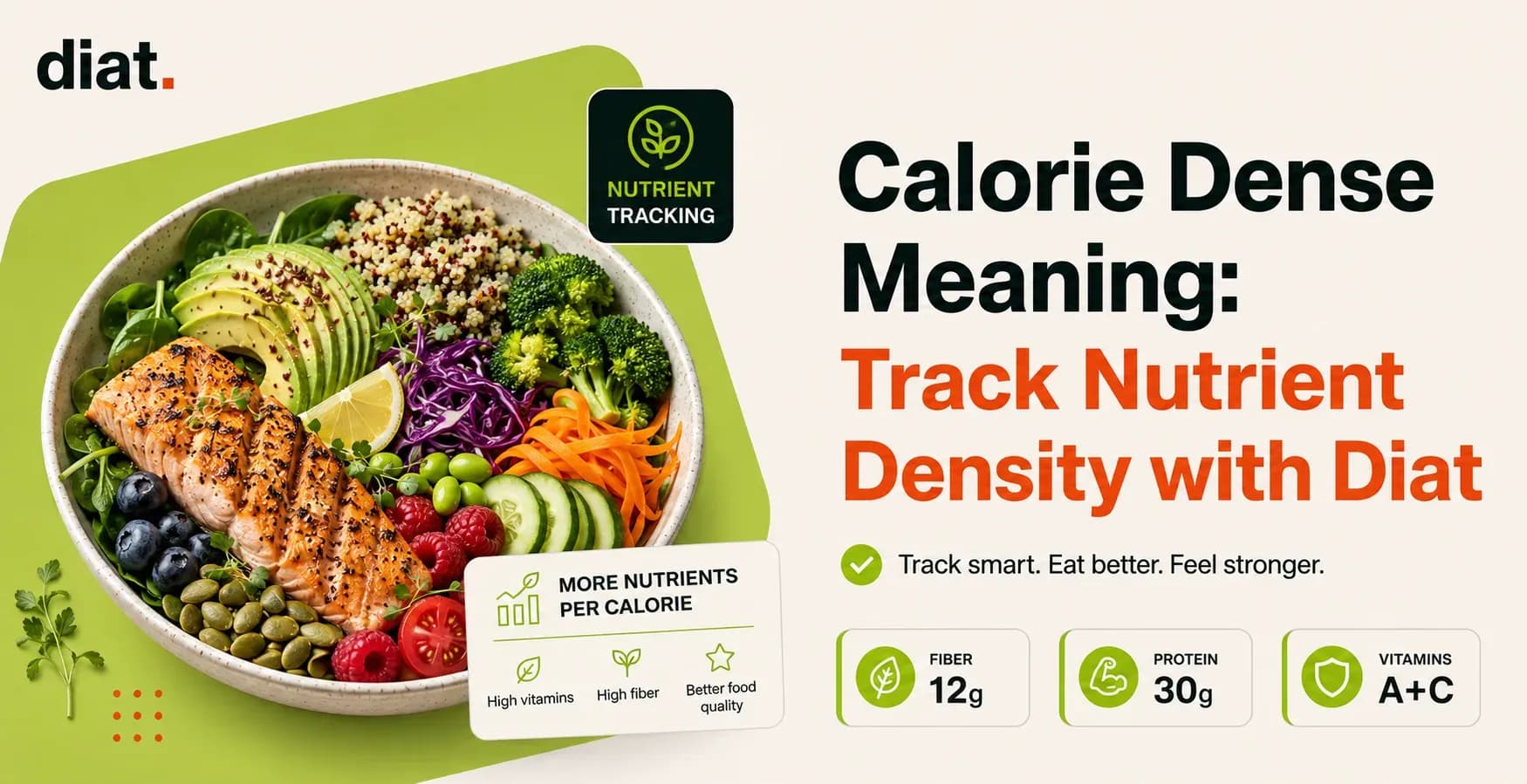
You order a small salad at a restaurant, finish it in five minutes, and still feel hungry. But when you look closely at the olive oil dressing, candied pecans, and avocado, that small bowl contained 800 calories. That is calorie density in action.
What is the calorie dense meaning?
Calorie density refers to the number of calories present in a specific weight or volume of food. High-calorie-dense foods pack a massive amount of energy into a very small physical footprint (like peanut butter or oil). Low-calorie-dense foods provide a large physical volume for very few calories (like spinach, cucumbers, or broth).
If you want to understand how your meals break down without doing complex math, the fastest way to start is by seeing the data. Diat is free to download!
Note on Calorie Restriction: If you have a history of disordered eating, are pregnant or breastfeeding, or are managing a medical condition, consult a healthcare provider before making changes to your diet or tracking calories. Eating disorder support resources are available globally, including the National Alliance for Eating Disorders.

What Diat Does: Visualizing Density
Tracking a nutrient-dense diet requires knowing what is actually on your plate. Research published in the National Library of Medicine highlights that balancing low-calorie-dense foods with nutrient-dense options is associated with better weight management and satiety. But doing that manually takes time.
Diat removes the manual database search. You photograph your plate, and the AI estimates the calories and macros (protein, fat, and carbohydrates). Because fats contain 9 calories per gram compared to 4 calories per gram for carbs and proteins, seeing a food's macro breakdown instantly helps you understand why a handful of almonds carries the same energy weight as three whole apples.
How to Track Your First Meal in Diat
Knowing the calorie dense meaning only helps if you apply it. Here is how to log a meal to see its macro breakdown:
- Open the Diat app on your phone.
- Tap the Log Meal icon and point your camera at your plate.
- Snap the photo.
- Review the estimated calorie count and macro breakdown generated by the AI.
- Confirm the entry or adjust the portion size manually if needed.
If the AI estimate looks off—and sometimes it will, especially with hidden oils—you can edit portions manually. Getting close is more useful than not logging at all.
The photo takes less than 10 seconds. Download free!
Calorie Dense vs. Nutrient Dense Foods
A food can be high in calories but still highly nutritious. Here is how common foods compare when you track them:
Category | High Calorie Density (High Energy, Small Volume) | Low Calorie Density (Low Energy, High Volume) |
|---|---|---|
High Nutrient Density | Olive oil, almonds, peanut butter, avocados, chia seeds | Spinach, broccoli, strawberries, bell peppers, zucchini |
Low Nutrient Density | Candy bars, potato chips, sugary sodas, fast food pastries | Diet sodas, artificial syrups, ice pops (mostly water and sweeteners) |
Data aligned with general dietary guidelines from the USDA MyPlate.
To build a sustainable tracking habit, focus on hitting your macro targets using a balance of high-volume foods to keep you full, and nutrient-dense fats for overall health.
Honest Tracking: AI Photo Limitations
Diat's photo logging is designed for the moments when you do not have time to search a database—snap, confirm, move on. However, AI estimates are approximations. The AI is highly effective at identifying whole foods, single ingredients, and standard portion sizes.
It struggles with hidden fats, mixed restaurant sauces, and dense oils cooked into a dish. For perfect precision, manual text entry remains the most accurate method. But for identifying patterns and actually sticking to a daily tracking habit, an 80% accurate photo log is vastly superior to a skipped entry.
Start Tracking Your Meals
The fastest way to test any food-tracking approach is to use it for one week. See exactly how calorie-dense your typical meals are without the friction of typing everything into a search bar. Join users building better habits.
Diat is free to download, available on both iOS and Android.
Reminder: Diat is a food tracking and wellness tool, not a medical device, and does not replace the advice of a healthcare professional.