

You ate a normal lunch, and by 3:00 PM, your stomach is visibly distended, painful, and unpredictable. If you have Irritable Bowel Syndrome (IBS), you already know that generic advice like "eat more fiber" often makes things worse. You need to know exactly which foods are causing the reaction.
There is no single "IBS diet" because triggers differ wildly from person to person. However, the approach with the strongest clinical evidence is the low-FODMAP diet. Developed by researchers at Monash University, this protocol works by removing the most common fermentable carbohydrates for a short period, then adding them back one by one to identify your personal triggers. According to Monash, up to 75% of people with IBS experience meaningful relief using this method.
Key Takeaways
- FODMAPs are fermentable carbs: They draw water into the gut and produce gas, causing IBS symptoms in sensitive individuals.
- It is not a permanent diet: The protocol involves an elimination phase (2–6 weeks), a reintroduction phase, and a personalization phase.
- Portions matter: Many foods are low-FODMAP in small servings but high-FODMAP in large ones.
- Tracking is mandatory: Identifying triggers requires logging exactly what you eat and how you feel daily.
What Are FODMAPs?
FODMAP stands for Fermentable Oligosaccharides, Disaccharides, Monosaccharides, and Polyols. They are short-chain carbohydrates that are poorly absorbed in the small intestine. When they reach the large intestine, bacteria ferment them quickly.
For someone without IBS, this fermentation is a normal part of digestion. For a sensitive gut, it creates excess gas, draws in water, and triggers bloating, pain, diarrhea, or constipation.
According to the National Institute of Diabetes and Digestive and Kidney Diseases (NIDDK), the main groups include:
- Oligosaccharides (Fructans and GOS): Found in wheat, rye, onions, garlic, and legumes.
- Disaccharides (Lactose): Found in cow's milk, soft cheeses, and regular yogurt.
- Monosaccharides (Excess Fructose): Found in honey, apples, pears, mangoes, and high-fructose corn syrup.
- Polyols (Sugar Alcohols): Found in sorbitol, mannitol, xylitol, stone fruits, mushrooms, and cauliflower.
High-FODMAP Foods to Remove (The Elimination Phase)
For 2 to 6 weeks, you will strictly limit high-FODMAP foods. This calms the gut and provides a baseline to test triggers against later.
Food Category | Foods to Avoid (High FODMAP) | Safe Swaps (Low FODMAP) |
|---|---|---|
Grains | Wheat and rye bread, pasta, couscous | Sourdough spelt, gluten-free bread, rice, oats, quinoa |
Vegetables | Onion, garlic, cauliflower, mushrooms, asparagus | Carrots, zucchini (courgette), spinach, bell peppers, cucumber, potatoes |
Fruit | Apples, pears, mangoes, watermelon, cherries, dried fruit | Firm bananas, blueberries, strawberries, oranges, kiwi |
Dairy | Cow's milk, soft cheese, regular yogurt, ice cream | Lactose-free milk/yogurt, hard cheeses (cheddar, parmesan), small amounts of feta |
Legumes | Chickpeas, lentils, kidney beans (standard portions) | Firm tofu, tempeh, small amounts of canned lentils (rinsed well) |
Sweeteners | Honey, agave, sorbitol/xylitol products | Maple syrup, moderate table sugar |
Note on onions and garlic: These are the hardest to give up, as they are in almost all savory recipes. Because fructans are water-soluble but not fat-soluble, garlic-infused olive oil is low-FODMAP and serves as the standard cooking workaround.

The 7-Day Low-FODMAP Meal Plan
This plan represents a typical elimination week. Portions are for one person. Season foods with salt, pepper, herbs, ginger, chili (if tolerated), lemon, and garlic-infused oil.
Day 1
- Breakfast: Oats (40g) made with lactose-free milk, topped with a sliced firm banana and 1 tbsp peanut butter.
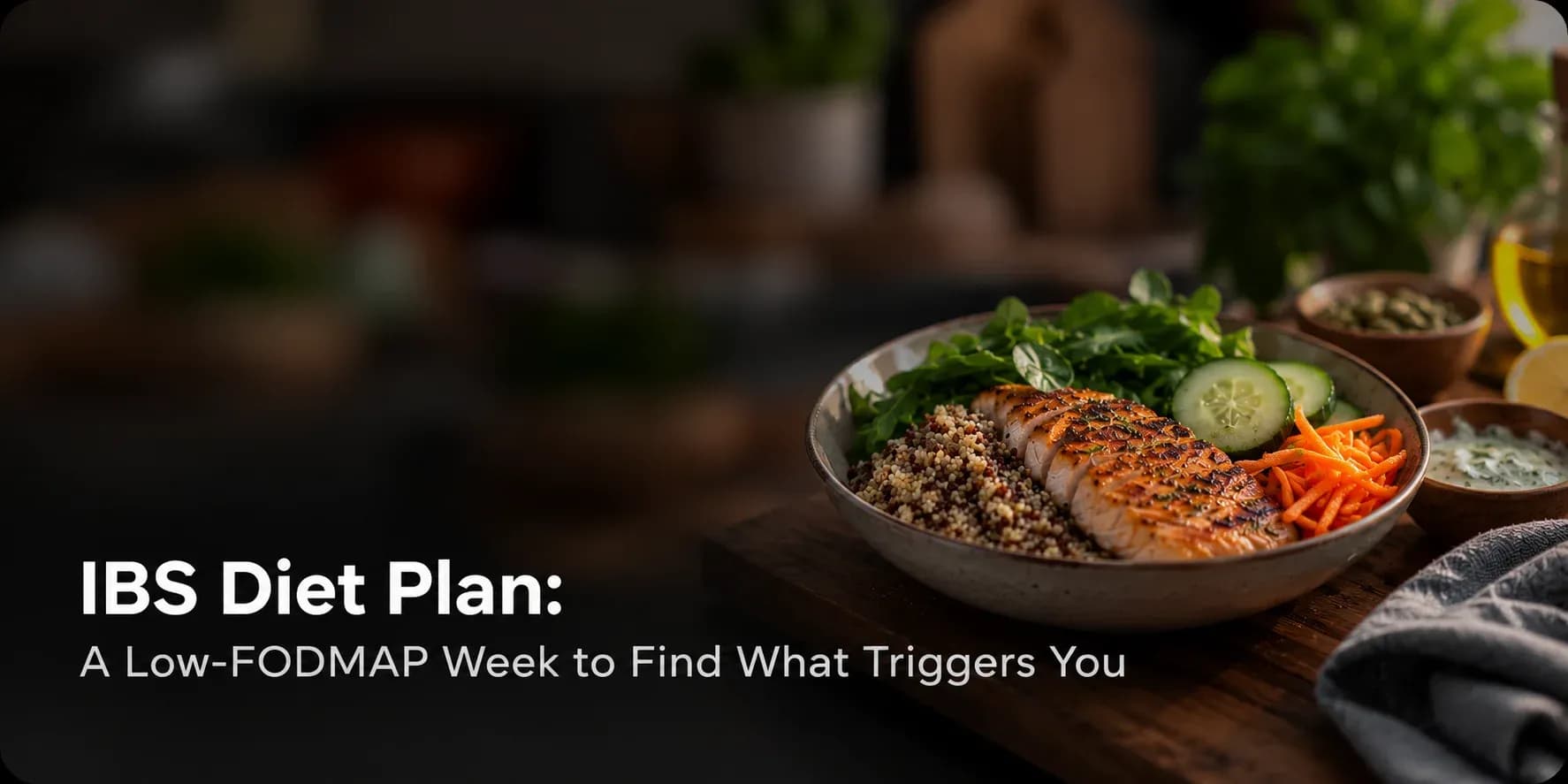
- Lunch: Rice bowl with grilled chicken, cucumber, shredded carrots, spinach, sesame oil, and a squeeze of lime.
- Dinner: Baked salmon, roasted potatoes, and steamed green beans.
- Snack: A handful of strawberries and 30g of cheddar cheese.
Day 2
- Breakfast: Scrambled eggs with spinach and tomato on sourdough spelt toast.
- Lunch: Quinoa salad with 30g feta cheese, cucumber, bell peppers, olives, olive oil, and lemon juice.
- Dinner: Turkey stir-fry with zucchini, bell peppers, ginger, and rice noodles cooked in garlic-infused oil.
- Snack: One orange and 10 walnut halves.
Day 3
- Breakfast: Lactose-free yogurt with blueberries and 30g gluten-free granola.
- Lunch: Leftover turkey stir-fry.
- Dinner: Pan-fried firm tofu, roasted eggplant and bell peppers, brown rice, tamari (gluten-free soy sauce), and sesame seeds.
- Snack: Rice cakes with peanut butter and a kiwi.
Day 4
- Breakfast: Omelet with feta and spinach, served with one slice of gluten-free toast.
- Lunch: Baked potato topped with canned tuna, cucumber, tomato, and a small amount of standard mayonnaise.
- Dinner: Grilled chicken thighs, quinoa, roasted carrots and zucchini, lemon, and fresh herbs.
- Snack: Firm banana and lactose-free yogurt.
Day 5
- Breakfast: Oats with lactose-free milk, strawberries, and pumpkin seeds.
- Lunch: Leftover chicken with a green salad and boiled potatoes.
- Dinner: Baked cod with tomatoes, olives, and herbs, served with rice and steamed green beans.
- Snack: Grapes and 30g hard cheese.
Day 6
- Breakfast: Low-FODMAP smoothie (lactose-free milk, blueberries, firm banana, oats, peanut butter).
- Lunch: Rice paper rolls filled with shrimp, carrots, cucumber, lettuce, and a peanut-lime dipping sauce.
- Dinner: Beef and vegetable stew (carrots, potatoes, parsnips in moderation, fresh herbs, low-FODMAP stock).
- Snack: One orange and plain rice cakes.
Day 7
- Breakfast: Buckwheat pancakes topped with maple syrup and strawberries.
- Lunch: Leftover beef stew.
- Dinner: Roast chicken, roasted potatoes, carrots, zucchini, and gravy made from low-FODMAP stock.
- Snack: Kiwi and lactose-free yogurt.
After Elimination: The Reintroduction Phase
Remaining on the elimination phase indefinitely is a mistake. High-FODMAP foods contain vital prebiotics that feed healthy gut bacteria.
After 2 to 6 weeks, once your symptoms have significantly improved, you begin reintroduction. You test one FODMAP group at a time over three days, gradually increasing the portion size, while keeping the rest of your diet strictly low-FODMAP.
For example, you might test lactose by drinking a small amount of cow's milk on Day 1, a moderate amount on Day 2, and a large amount on Day 3. You then wait a few days, monitor your symptoms, and move on to test fructans (e.g., wheat bread).
Most people discover they only react strongly to one or two groups and can comfortably eat the rest.
How to Track Your Reintroduction in Diat
The reintroduction phase entirely depends on accurate logging. If you do not record exactly what you ate and how your stomach felt afterward, you cannot identify your triggers. Manual food diaries often get abandoned because typing every ingredient takes too long.
This is where Diat's photo-logging bridges the gap.
- Open the app and tap the camera icon on iOS or Android
- Snap a photo of your test meal (e.g., your test portion of wheat bread alongside your low-FODMAP eggs).
- Review the estimate. AI photo estimation is an approximation, but for trigger-tracking, the visual record and time-stamp are exactly what you need.
- Log your symptoms in the daily notes later that afternoon.
When you review your week, you can see exactly which meal preceded the bloating. The photo takes less than 10 seconds. Diat is free to download.
Beyond FODMAPs: Other Common IBS Triggers
According to guidelines from the NHS, FODMAPs aren't the only culprits.
- Fiber types: Soluble fiber (oats, psyllium) often helps regulate bowel movements, especially for constipation-predominant IBS. Insoluble fiber (wheat bran) can irritate the gut and make symptoms worse.
- Meal timing: Leaving large gaps between meals and then eating heavily can trigger symptoms.
- Gut irritants: Alcohol, caffeine, spicy foods, and high-fat meals can trigger IBS independently of their FODMAP content.
- The Gut-Brain Axis: Stress, anxiety, and poor sleep affect gut motility directly. Managing stress is a clinical part of IBS treatment.
