

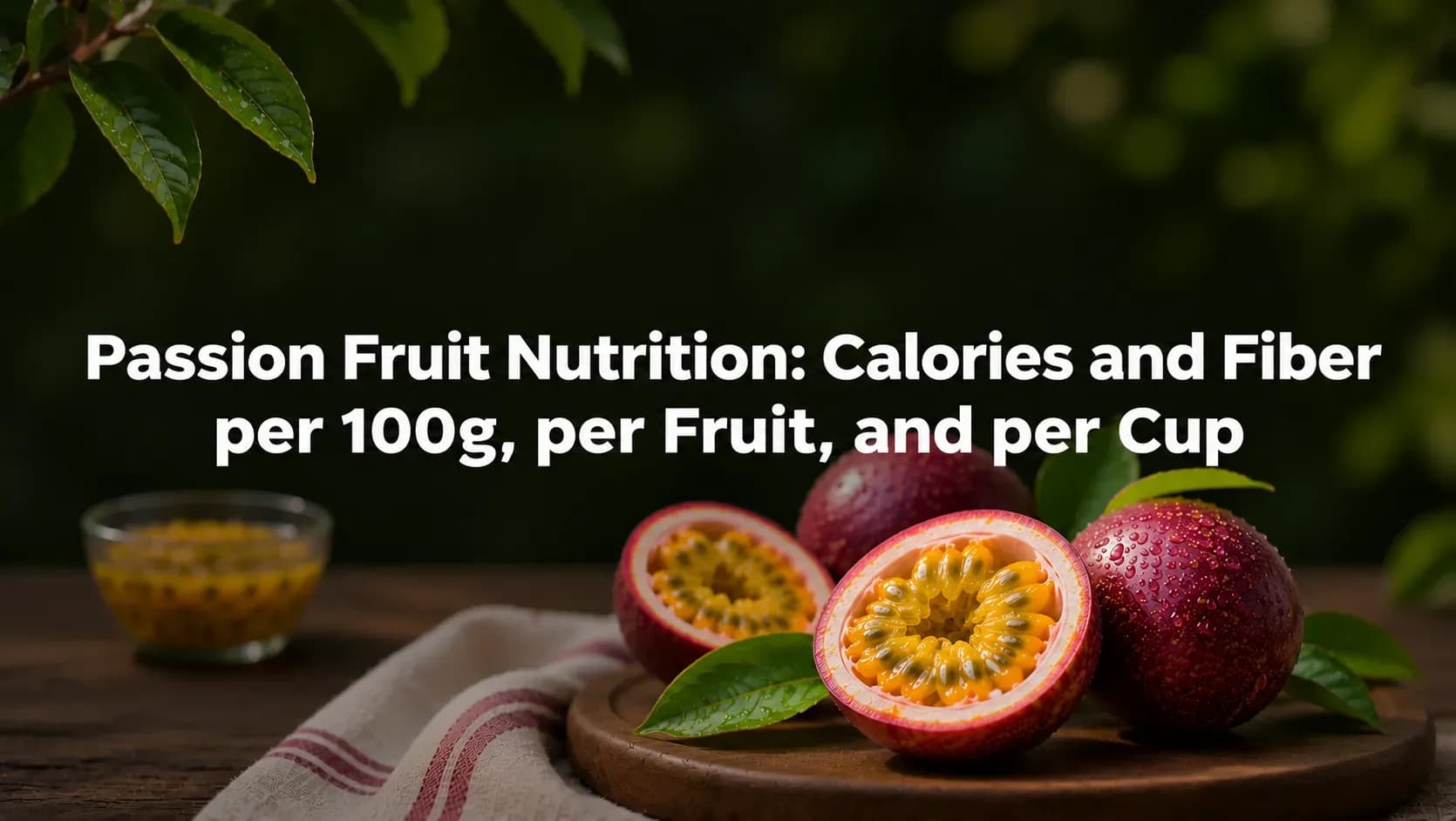
One passion fruit (about 18 g of pulp and seeds) has roughly 17 calories and 1.9 g of fiber. Per 100 g, passion fruit has 97 calories, 10.4 g of fiber, 23.4 g of carbs, and 30 mg of vitamin C, based on USDA FoodData Central. Most of its carbs come from fiber and natural sugar.
Want to log it in seconds? Diat is free to download on iPhone and Android.

Passion Fruit Nutrition Facts per 100g, per Fruit, and per Cup
The table below uses USDA values for raw purple passion fruit. The figures count the edible pulp and seeds, not the rind.
Nutrient | Per 100 g | Per fruit (18 g) | Per cup (236 g) |
|---|---|---|---|
Calories | 97 kcal | 17 kcal | 229 kcal |
Carbohydrates | 23.4 g | 4.2 g | 55.2 g |
Fiber | 10.4 g | 1.9 g | 24.5 g |
Total sugars | 11.2 g | 2.0 g | 26.4 g |
Protein | 2.2 g | 0.4 g | 5.2 g |
Fat | 0.7 g | 0.1 g | 1.7 g |
Vitamin C | 30 mg | 5.4 mg | 70.8 mg |
Potassium | 348 mg | 63 mg | 821 mg |
Iron | 1.6 mg | 0.3 mg | 3.8 mg |
Water | 72.9 g | 13.1 g | 172 g |
Source: USDA FoodData Central, SR Legacy, FDC 169108. Per-fruit and per-cup values are calculated from the per-100 g data.
How Many Calories Are in Passion Fruit?
Passion fruit has 97 calories per 100 g and about 17 calories per fruit. Nearly all of that energy comes from carbohydrates. Protein and fat add very little.
Portion size changes the number fast. A full cup (236 g) holds about 229 calories, but that is the pulp of roughly 13 fruits. Most people eat one to three at a time, which is about 17 to 52 calories.
If you want to see how a snack like this fits your day, Diat’s free calorie calculator estimates your daily needs. You can also read our guide on how many calories a meal should be.
How Much Fiber Is in Passion Fruit?
Passion fruit has 10.4 g of fiber per 100 g, or about 1.9 g per fruit (USDA). That means 100 g covers about 37% of the FDA Daily Value for fiber, which is 28 g a day.
The NHS advises adults to aim for 30 g of fiber a day. Most adults in the UK only eat about 20 g. The NHS also notes that eating plenty of fiber is linked with a lower risk of heart disease, stroke, type 2 diabetes, and bowel cancer.
Two tips work with or without an app:
- Raise fiber slowly. A sudden jump can cause gas or bloating. NHS Tayside also advises drinking enough fluid as you eat more fiber.
- Eat the pulp, not just the juice. Strained juice loses almost all of the fiber (see the comparison below).
Not sure how much fiber you need? Try Diat’s free fiber intake calculator.

Vitamins and Minerals in Passion Fruit
Passion fruit is a good source of vitamin C. Per 100 g, it gives 30 mg, about 33% of the 90 mg FDA Daily Value.
It also provides smaller amounts of other nutrients per 100 g (USDA):
- Potassium: 348 mg (about 7% DV)
- Iron: 1.6 mg (about 9% DV)
- Vitamin A: 64 µg RAE (about 7% DV)
- Magnesium: 29 mg (about 7% DV)
Passion Fruit vs. Passion Fruit Juice
Whole pulp and strained juice look similar, but their nutrition is very different.
Per 100 g | Whole pulp | Raw juice |
|---|---|---|
Calories | 97 kcal | 51 kcal |
Fiber | 10.4 g | 0.2 g |
Total sugars | 11.2 g | 13.4 g |
Sources: USDA FDC 169108 (fruit) and 169109 (juice).
The juice has fewer calories per 100 g, but almost no fiber. If fiber is your goal, scoop and eat the pulp with its seeds.
How to Log Passion Fruit in Diat
Logging takes less than a minute:
- Open Diat and add food to the meal you’re logging.
- Search “passion fruit” or snap a photo of the pulp.
- Set the amount in grams or by number of fruits.
- Check the breakdown of calories, carbs, fiber, protein, and fat.
- Save it to your daily log.
A note on accuracy: Photo estimates are approximations. They can miss portion size, especially for scooped fruit in a bowl. If the number looks off, edit the portion by hand. Diat marks AI-estimated entries in its food database, so you can tell them apart from USDA-sourced values. Logging close to the right amount is more useful than not logging at all.
Diat is free to download, with optional Premium for unlimited logging. Rated 4.9/5. Get it on iPhone or Android.
Who Should Be Careful With Passion Fruit?
People with a latex allergy. Passion fruit is one of the fruits linked to latex-fruit syndrome. In a study in Allergy, some latex-allergic people had antibodies that also reacted to passion fruit. If you have a latex allergy, talk to an allergist first.
People with a medical condition that affects diet. If you manage blood sugar, kidney health, or another condition, ask your healthcare provider how fruit fits your plan.
A note on calorie tracking. Tracking food is not right for everyone. This includes people with a history of disordered eating, pregnant or breastfeeding people, and people with certain medical conditions. Speak with a doctor or registered dietitian before making big diet changes. If food or eating feels hard to manage, eating disorder support services such as Beat (UK) or the National Alliance for Eating Disorders (US) can help.
