
You know you need vitamins to function, but translating a clinical list of nutrients into an actual grocery trip is where most people get stuck. You log your breakfast, struggle to find the exact brand of spinach you bought, and by dinner, you are estimating. By day four, you have stopped tracking entirely.
If you want to know what vitamins ABCDE are, the answer is straightforward: they are essential micronutrients your body requires to maintain vision, energy metabolism, immunity, bone density, and cellular protection. To get reliable sources of vitamins A, B, C, D, E, and K, eat a varied diet of whole foods.
Tracking that intake shouldn't require a biochemistry degree. Here is exactly what these vitamins do, where to find them, and how to track your meals without the database fatigue.
What is the Function of Vitamin ABCDE and K?
Vitamins are organic compounds required in small quantities to sustain life. According to the U.S. Food and Drug Administration (FDA), your body cannot synthesize most of these natively, meaning they must come from your diet or supplements.
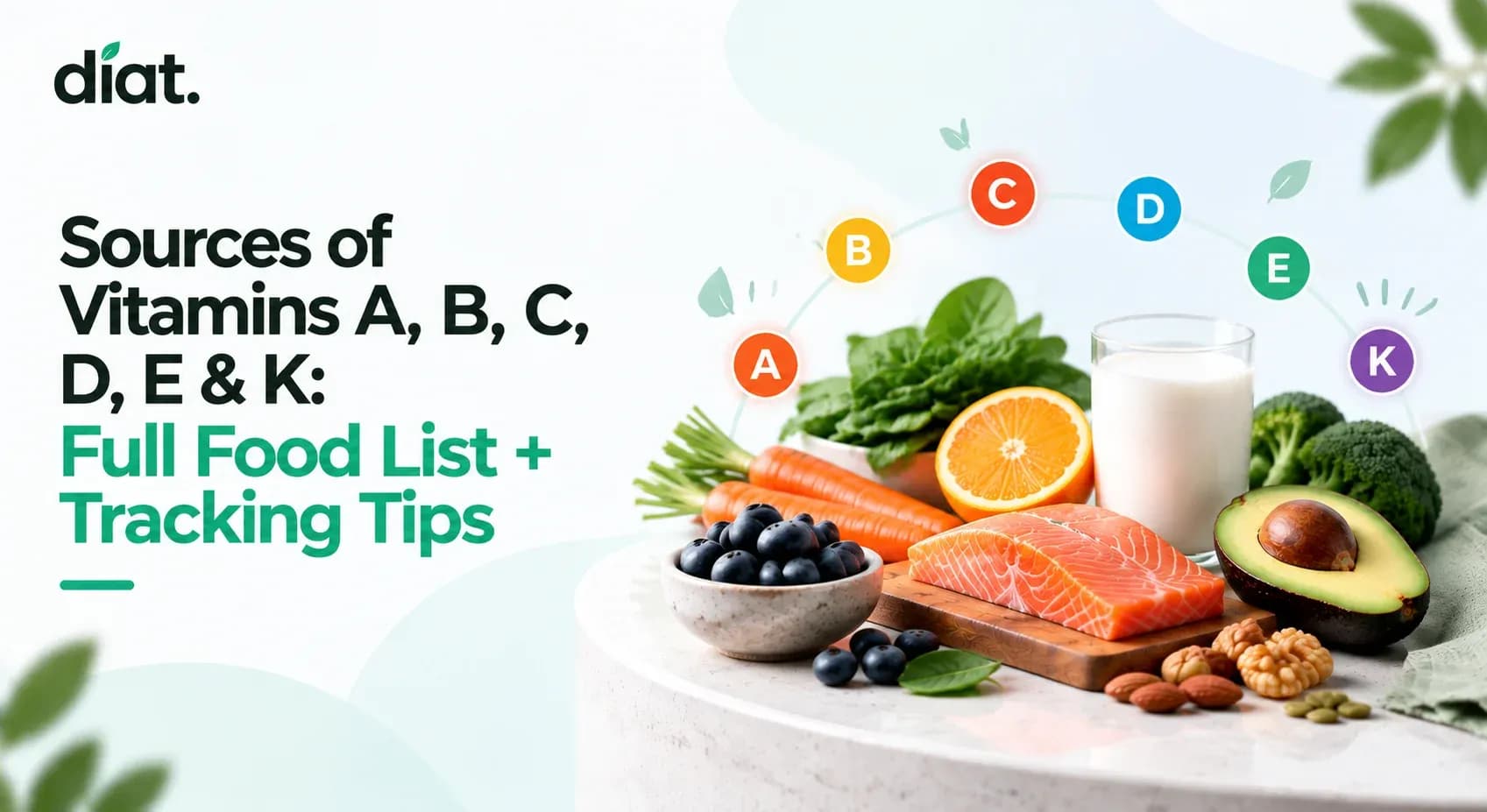
Here is an all-vitamins food list breaking down the functions and 5 sources of vitamins for each category, based on data from Harvard Medical School:
Vitamin | Primary Function | 5 Common Food Sources |
|---|---|---|
Vitamin A | Supports vision, immune function, and skin health. | Sweet potatoes, carrots, spinach, beef liver, cantaloupe. |
Vitamin B (Complex) | Aids energy metabolism and red blood cell creation. | Salmon, leafy greens, eggs, legumes, nutritional yeast. |
Vitamin C | Acts as an antioxidant; vital for collagen production and immunity. | Citrus fruits, bell peppers, strawberries, broccoli, tomatoes. |
Vitamin D | Regulates calcium absorption for bone health. | Fatty fish (salmon, tuna), fortified milk, egg yolks, mushrooms, sunlight. |
Vitamin E | Protects cells from oxidative stress and free radical damage. | Almonds, sunflower seeds, spinach, avocados, olive oil. |
Vitamin K | Essential for blood clotting and bone metabolism. | Kale, spinach, broccoli, Brussels sprouts, soybeans. |
(Note on the best B complex for men: While food sources are optimal, men seeking supplemental B-complex for energy metabolism support should look for formulations containing B12, B6, and Folate. Always consult a physician before supplementing, as backed by NCBI research.)

What Diat Does: Faster Nutrient Tracking
Knowing 10 examples of vitamins is only half the battle. Consistently eating them is the other.
Manual database entry is the primary reason people quit tracking their food. Diat’s AI calorie counter changes the workflow. Instead of typing "roasted salmon with spinach," you snap a photo of your plate.
The AI estimates your calories, provides a macro breakdown and generates smart recipe ideas based on your habits. This approach is designed for the moments when you do not have time to search a database—snap, confirm, and move on.
The fastest way to test any food-tracking approach is to use it for one week. Diat is free to download.
How to Log Your First Meal in Diat
Habit is what produces results over time, not logging precision. Here is how to log a vitamin-dense meal in under ten seconds:
- Open the app on your phone
- Tap 'Log Meal' and point your camera at your plate.
- Review the estimate. The AI will approximate the nutritional breakdown of your food.
- Confirm or adjust. If the AI estimate looks off—and sometimes it will—you can edit portions manually. Getting close is more useful than not logging at all.
The photo takes less than 10 seconds. You can start building the habit today.
An Honest Note on AI Tracking Accuracy
AI photo-based calorie estimation is a powerful time-saver, but it is not perfect. AI estimates are approximations. The system works exceptionally well for single-ingredient foods and simple plates (like a banana or a grilled chicken breast).
It struggles with mixed dishes, hidden cooking oils, and dense sauces. For precise clinical micronutrient tracking, manual database entry remains more accurate. However, Diat is built on the philosophy that a "close enough" log you actually complete is far more valuable than a perfect log you abandon by Tuesday.
Download for free and log your first meal today. https://diat.app/download
