

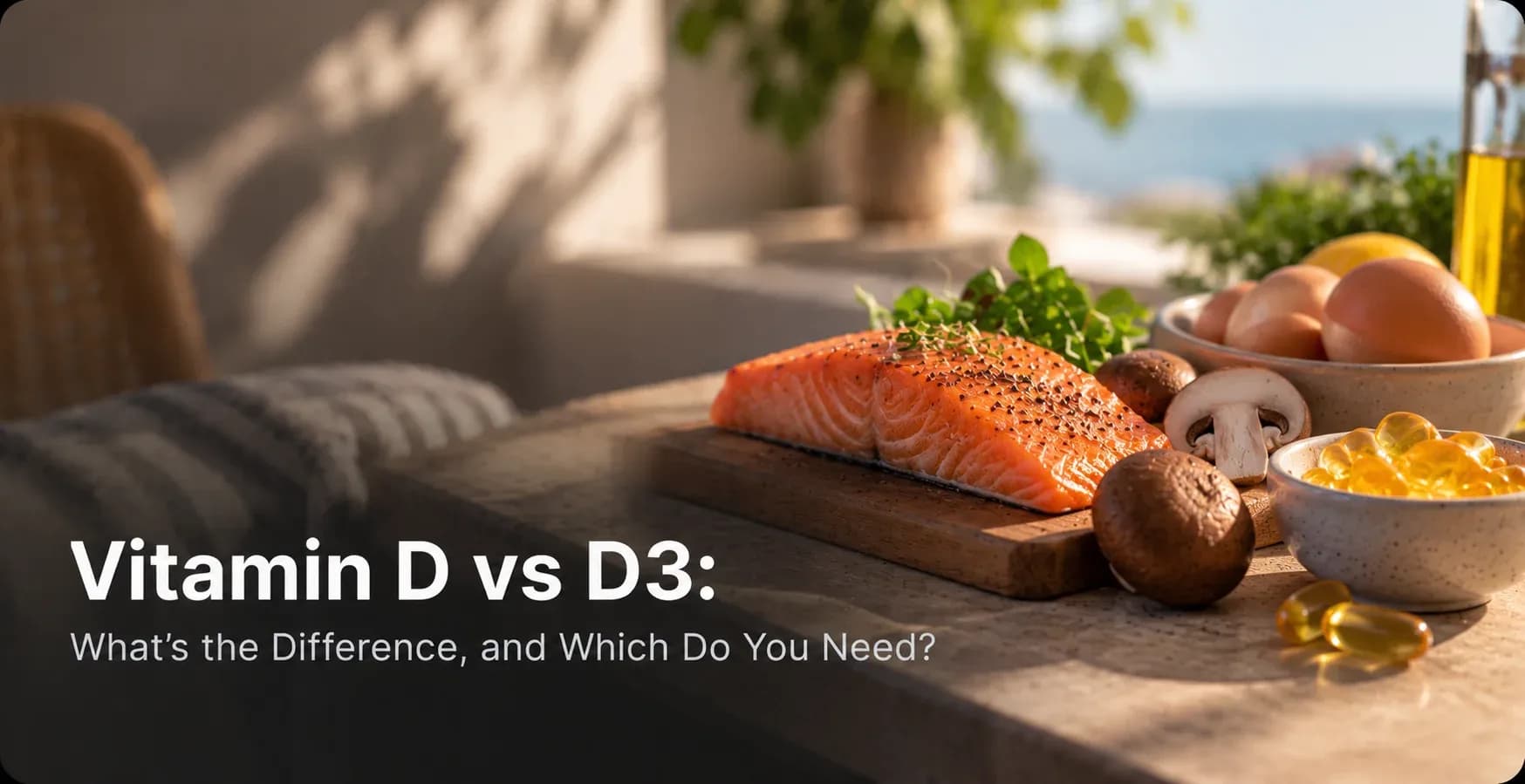
You are standing in the supplement aisle reading labels. Half the bottles say "Vitamin D." The other half say "Vitamin D3." A few specify "Vitamin D2." If you are trying to fix a deficiency or hit your daily micronutrient targets, grabbing the wrong bottle means your body might not absorb what you are paying for.
The short answer: Vitamin D is the family name. Vitamin D3 (cholecalciferol) is the specific form your body makes from sunlight and absorbs from animal foods. Vitamin D2 (ergocalciferol) comes from plants and fungi. As noted by experts at the Cleveland Clinic, if you are buying a supplement, vitamin D3 is the better choice because it raises and maintains your blood vitamin levels more effectively than D2.
If you want to see how much Vitamin D you are already getting from your meals before buying supplements, Diat’s photo-logging app breaks down your daily intake in seconds. Download free now!
The Difference Between Vitamin D and D3
"Is vitamin D the same as vitamin D3?" Yes and no. Vitamin D is the umbrella term for two distinct compounds. The family of Vitamin D includes Vitamin D2 and D3.
- Vitamin D2 (Ergocalciferol): Sourced from plants. It is found in UV-exposed mushrooms and is often used to fortify plant milks.
- Vitamin D3 (Cholecalciferol): Sourced from animals and sunlight. It is found in oily fish, egg yolks, and liver. Over-the-counter D3 supplements are usually made from lanolin (sheep's wool), though vegan vitamin D3 derived from lichen is now widely available.
Which is better, vitamin D or D3?
Clinical research consistently shows that Vitamin D3 is superior. According to studies indexed by the National Institutes of Health (NIH), D3 binds more strongly to the transport proteins in your blood. This means a single dose of D3 raises your active vitamin levels higher, and keeps them elevated longer, than the exact same dose of D2.

Top Foods Rich in Vitamin D
You cannot easily reach the recommended 600 IU from unfortified food alone, but incorporating these sources helps. Here are common foods rich in Vitamin D (approximations based on NIH Office of Dietary Supplements data):
Food | Vitamin D per serving | Type |
|---|---|---|
Cod liver oil (1 tablespoon) | ~1,360 IU | D3 |
Salmon, cooked (3 oz / ~85 g) | ~447 IU | D3 |
UV-exposed mushrooms (1/2 cup) | ~366 IU | D2 |
Fortified plant or dairy milk (1 cup) | ~100-120 IU | D2 or D3 (check label) |
Sardines, canned (2 sardines) | ~46 IU | D3 |
Egg yolk (1 large) | ~44 IU | D3 |
How to Track Your Vitamin D3 Intake in Diat?
Most adults need 600 IU (15 mcg) of Vitamin D per day (800 IU if over age 70), according to the NIH Office of Dietary Supplements. Before you start taking high-dose supplements, it helps to know your baseline.
Diat allows you to track your meals visually to estimate your nutrient breakdown.
How to log a meal in Diat:
- Open the Diat app on your phone.
- Tap Log Meal and point your camera at your plate (e.g., a salmon salad).
- The AI scans the image and estimates your calories, macros, and nutrient profile.
- Review the breakdown, adjust the portion size if needed, and confirm.
Honest accuracy note: Diat's AI photo estimation is built for speed and habit-building, but it has limits. An AI cannot see if your glass of oat milk is fortified with Vitamin D, or if your mushrooms were UV-exposed. For fortified or hidden ingredients, you will need to adjust the entry manually. AI estimates are approximations, use them to spot patterns, not for exact medical dosing.
The photo takes less than 10 seconds. Download free now!.
Vitamin D2 vs D3: Comparison Breakdown
Here is a quick reference for the two main forms of this essential nutrient:
Feature | Vitamin D2 (Ergocalciferol) | Vitamin D3 (Cholecalciferol) |
|---|---|---|
Primary Source | Plants, fungi, fortified foods | Sunlight, animal products, lichen |
Effectiveness | Lower absorption and retention | Higher absorption; lasts longer in blood |
Common Foods | UV-mushrooms, fortified plant milk | Salmon, sardines, egg yolks, liver |
Supplement Source | Yeast irradiation | Lanolin (sheep wool) or Lichen (vegan) |
Vitamin D3 Dosage and Safety
How much vitamin D3 per day?
The RDA assumes you get minimal sun exposure. Because it is difficult to reach 600 IU through food alone (one egg yolk only has ~40 IU), many adults in northern climates take 1,000-2,000 IU of D3 daily during winter.
Best time to take vitamin D3:
Vitamin D is fat-soluble. Taking it on an empty stomach drastically reduces absorption. Take your supplement with breakfast or dinner, whichever meal contains the most healthy fats (like olive oil, avocado, or eggs).
Can you take too much vitamin D3?
Yes. The NIH sets the safe upper limit for adults at 4,000 IU (100 mcg) per day. Because it is stored in your fat cells, excess Vitamin D builds up and can cause calcium toxicity in your blood. Never take high-dose supplements (like 10,000 IU) without a blood test and direct medical supervision.
If you are experiencing vitamin D deficiency symptoms, like deep fatigue, bone aches, or frequent winter colds, ask your doctor for a 25(OH)D blood test.
