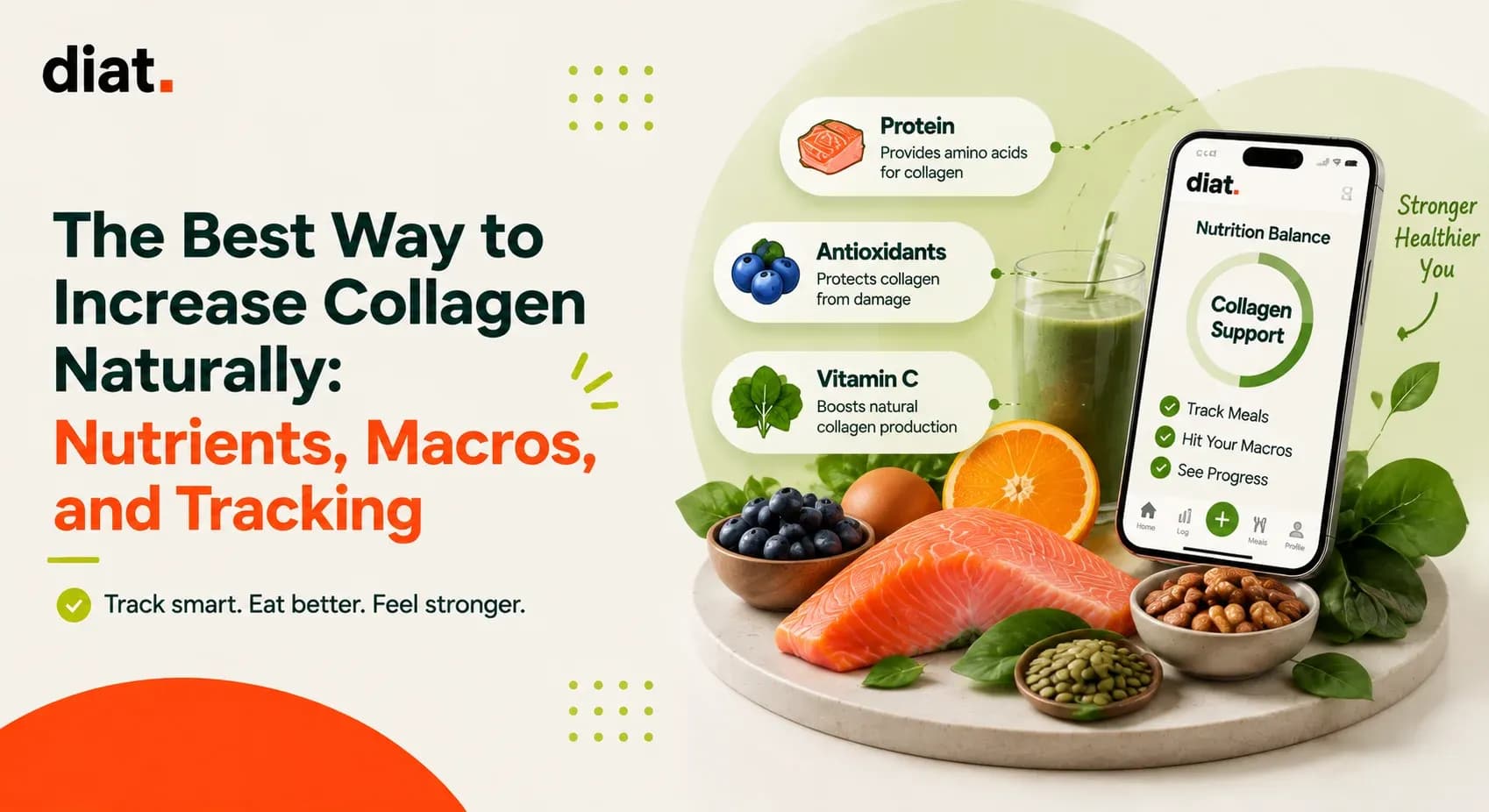
If you are tracking your nutrition to support skin and joint health, you have likely encountered conflicting advice about collagen. Between powders, bone broths, and expensive supplements, the nutrition industry heavily markets the idea that consuming collagen directly translates to more collagen in your body.
The clinical reality is different. According to the Harvard T.H. Chan School of Public Health, your body cannot absorb collagen whole. When you eat it, your digestive system breaks it down into amino acids. The best way to increase collagen is to consistently consume enough protein (specifically amino acids like glycine and proline) and Vitamin C so your body can synthesize collagen on its own.
Tracking the foods that provide these building blocks can be tedious. Diat (https://diat.app) simplifies this by using AI photo estimation to help you track your meals, macros, and nutrients in seconds, without digging through search databases.
Health & Safety Notice: Diat is a food tracking and wellness tool, not a medical device. It does not replace the advice of a healthcare professional, registered dietitian, or physician. If you have a medical condition that affects your nutrition, or if you are considering significant dietary changes, consult your healthcare provider first.
Why You Can't Just "Eat" Collagen
Your body’s natural collagen production begins to decline slightly in your 20s and drops more significantly after menopause, according to the Cleveland Clinic.
To build collagen naturally, your body requires:
- Amino Acids: Primarily glycine, proline, and hydroxyproline (found in protein-dense foods).
- Vitamin C: A mandatory cofactor for collagen synthesis (found in citrus, bell peppers, and leafy greens).
- Zinc and Copper: Essential trace minerals for tissue repair.
Expanding your diet to include these nutrients often means exploring new whole foods and expanding your taste palate (often misspelled in food tracking forums as "taste pallette" or "taste palete" — the literal palette food meaning simply refers to how you perceive and appreciate different flavors). Whether you follow a strict macro-counting plan, a soy free vs flexitarian diet, or simply want to eat more protein, tracking your daily intake ensures you are giving your body what it needs.
How Diat Helps You Track Collagen-Building Macros
Most people start using food trackers to answer basic calorie questions—like comparing ice cream vs frozen yogurt calories. But over time, the focus shifts from restricting calories to optimizing macros like protein.
Diat is designed to remove the friction of manual database searching. Instead of typing "4 ounces of grilled chicken with 1 cup of spinach," you simply photograph your plate.
How to Log a Collagen-Boosting Meal in Diat:
- Open the app on your phone and tap Log Meal.
- Point your camera at your plate (e.g., a Vitamin C-rich salad with lean protein).
- Review the AI's estimated calorie and macronutrient breakdown.
- Confirm or manually adjust the portions if needed.
The photo takes less than 10 seconds. You can download Diat for free on the App store and Google Play.

Honest Note on AI Accuracy: AI photo-based calorie and macro estimation is a powerful time-saver, but it is an approximation. Industry research indicates photo-based AI averages 80–85% accuracy compared to ~94% for strict manual database entry, struggling mostly with hidden cooking oils or complex sauces. However, getting a close estimate consistently is far more useful for building long-term tracking habits than demanding perfect accuracy that causes you to quit logging entirely.
Supplements vs. Whole Food Tracking
Method | How it Works | Evidence Base | Tracking Friction |
|---|---|---|---|
Collagen Peptides (Powder) | Hydrolyzed collagen broken down for easier absorption. | Some studies (NIH) suggest minor skin elasticity benefits, though research is often industry-funded. | Low friction. Easy to log manually. |
Bone Broth | Simmering animal bones to extract gelatin/collagen. | Historically rich in nutrients, but amino acid concentration varies wildly by batch. | Medium friction. Hard to estimate exact macros per cup. |
Whole Food Protein + Vitamin C | Eating high-quality proteins (poultry, fish, eggs) and produce. | Strongly supported by dietary guidelines (WHO, USDA) for overall health and tissue repair. | High friction manually; Low friction with Diat photo AI. |
Eating Disorder Safety Note: Tracking calories, macros, or engaging in fasting protocols is not appropriate for everyone. Individuals with a history of disordered eating, pregnant or breastfeeding individuals, and adolescents should avoid strict tracking or caloric restriction. If you or someone you know is struggling with an eating disorder, please consult a healthcare professional or contact local eating disorder support resources.
Build the Habit, See the Patterns
Increasing collagen naturally isn't about a single superfood; it's about consistently hitting your daily protein and micronutrient targets. Diat’s photo logging is designed for the moments when you don't have time to weigh your food or search a database — snap, confirm, move on.
Join 500k+ users building better nutritional awareness. Diat is free to download on the App Store and Google Play!